
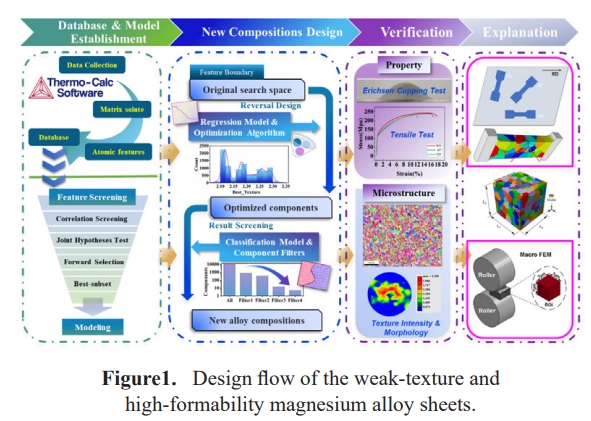
EXTENDED ABSTRACT: As a structural material with low density and high speciffc strength, magnesium alloy is one of the main candidate materials to respond to the current global climate crisis and control carbon emissions. However, magnesium alloys are difficult and costly to process at room temperature, which greatly limits their widespread applications. The difficult-to-process characteristics of magnesium alloys are mainly due to the strong basal texture caused by its hexagonal crystal structure during processing. Therefore, solving the problem of difffcult processing of magnesium alloys can be achieved by reducing the strength of the basal texture produced during processing. We combined machine learning, thermodynamic calculations, inverse design and forward screening to design the compositions and supporting key processes of several new rare-earth magnesium alloys with weak texture, good room temperature formability and ductility. The designed alloy composition, supporting key processes, and corresponding texture and mechanical properties have been well veriffed experimentally.
Keywords: Magnesium alloys; Machine learning; Alloy design
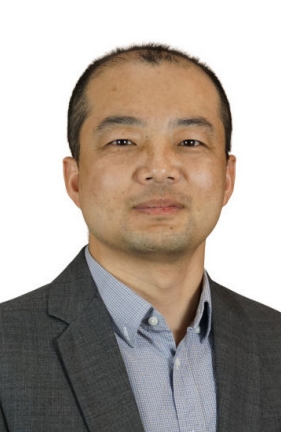
Weidong Li is a professor at University of Science of Technology Beijing, and was elected to the national young talents program. His research interests are primarily on structural metal alloys, integrated computational materials engineering, and applied machine learning in materials. He obtained his bachelor’s degree, master’s degree and Ph. D from China University of Geoscience (Beijing) in 2007, University of Science and Technology in 2010, and University of Tennessee in 2013, respectively. Following his graduation, he had been working in the R&D departments of three prestigious US companies, namely, Corning Inc., Goodyear Tire and Rubber Company, and Blue Origin. Since 2018, he has served as an adjunct assistant professor and then adjunct associate professor in the Department of Materials Science and Engineering at University of Tennessee. Throughout his career, he has published close to 50 peer-reviewed papers in internationally renowned journals such as Acta Mater., Adv. Mater, Prog. Mater. Sci., and Scripta Mater. He authored one monograph and three book chapters and ffled two international patent applications. He has organized and chaired several international conferences, and has been invited to give talks at international conferences.