
EXTENDED ABSTRACT: Intrinsically thermally conductive polymers are highly in demand for effective thermal management of energy devices, flexible electronics and power modules. However, since most polymers are thermally insulating, the exploration of intrinsically thermally conductive polymers is challenging. In this work, we have successfully design amorphous polymers with intrinsic high thermal conductivity by
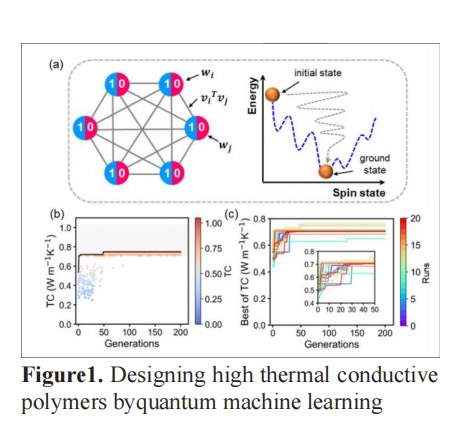
combining the sequence-ordered optimization and simulated quantum annealing. The proposed workflow consists of two steps: firstly, using a set of polymer substructure fragments as descriptors, 1144 polymers labeled with calculated thermal conductivity by NEMD are used to train the machine learning model. The model is used for predicting the thermal conductivity of subsequent design structures; On the other hand, the SHAP analysis is also used to extract the contribution of key substructures to thermal conductivity. Then, combined with the domain knowledge of the relationship between polymer microstructure and thermal conductivity, we establish the functional element libraries. Next, the simulated quantum annealing algorithm is used to optimize the sequence-order of the polymer functional units, in order to obtain high thermal conductive polymer structures. The proposed framework not only successfully breaks the bottleneck of high-throughput screening cases limited by the chemical space to be explored, but also compensates for the low efficiency of active learning optimization algorithm design caused by the large chemical space and redundant candidate structures. Theproposed approach provides a valuable tool for designing thermal conductive polymers.
Keywords:QuantumMachine learning; Activedesign; Highthermal conductive polymers; sequence-ordered optimization
Shenghong Ju received his B.S. degree from Nanjing University of Aeronautics and Astronautics in 2008, and he obtained his Ph.D. degree in Engineering Thermophysics from Tsinghua University in 2014. He conducted postdoctoral research in Ecole Centrale ParisandtheUniversit yofTokyofrom2014to2019.Heiscurrentlyanassociateprofessor in Shanghai JiaoTongUniversity. His research mainly focuses on the materials informatics and computational materials.